Mental health is a state of mental wellbeing that exists on a continuum and influences individuals’ abilities to cope with everyday stressors, and function in their daily lives. Everyone has their own personal mental health experience, which is influenced by many factors, from the individual level, social and environmental levels, all the way to the systemic level.1
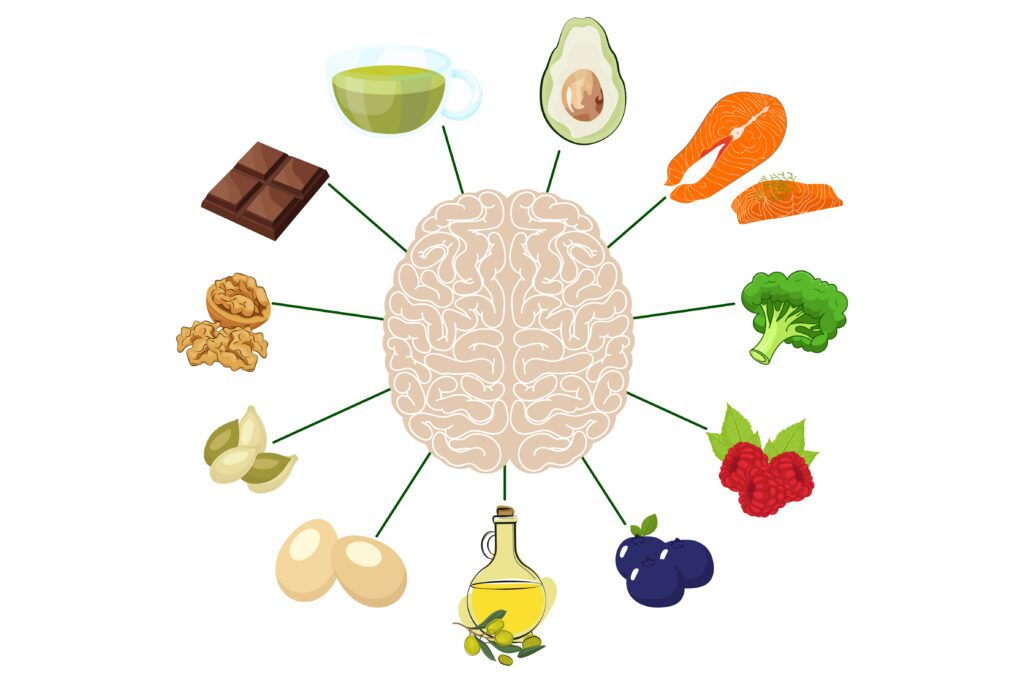
There is growing conversation around food and mental health; everywhere you look there seems to be messaging around how what you eat impacts how you feel. Available research does suggest there’s a connection, but it’s not as simple as you might think.
Are Diet and Mental Health Related?
The short answer: Yes, there is a connection.
The details: Research supports a relationship between diet quality and mental health. In general, balanced, nutrient-dense eating patterns are associated with better mental health. However, there is no standardized definition for “diet quality” in the existing research on this topic; different studies define and measure diet quality in different ways, limiting our ability to interpret research on a larger scale. Additionally, many studies indicate only correlation, not causation.
Taking the Research for What It’s Worth
Not all research studies are created equally. It’s easy to assume something is true because there’s a peer-reviewed paper to back it up, but interpreting research is more nuanced than that.
A few things to consider:
- Correlation vs. Causation: Just because two things, like diet quality and mental health, are linked, or correlated, it doesn’t mean one causes the other.
- Lack of Standardization: There is no universal definition of a “high quality diet”, and dietary interventions vary widely across research studies. Without standardization, it’s very difficult to translate research into clear, practical recommendations.
- Generalizability: Study results might be based on specific populations and may not apply to everyone. Confounding factors, such as genetics, socioeconomic status, education, stress, and other lifestyle factors can influence research outcomes. In addition, many populations are underrepresented in research, including racial and ethnic minorities, members of the LGBTQIA+ community, individuals of low socioeconomic status, and individuals residing in rural areas.
When it comes to health and wellbeing in real life, there are many factors at play, including social determinants of health like access to quality health care, social support, and even an individual’s environment.2
To sum it up: Research can give us helpful information, but it’s not perfectly applicable to everyone’s circumstances.
Specific Nutrients & Interventions
There are some randomized controlled trials (gold standard of research to establish causation) that show promise regarding nutrition interventions for mental health. To this point, most of the research has focused specifically on depression.
One of the most studied dietary patterns related to mental health impacts is the Mediterranean diet, which is often used in research as one way researchers attempt to model a “high quality” dietary pattern. Some studies show improvements in depressive symptoms with this dietary pattern, but results are mixed and studies are relatively few.3,4
Certain nutrients have been studied in greater depth, and there is some evidence that supplementation may improve depressive symptoms in adults with depression, especially when a deficiency is present:
- Omega-3 fatty acids5
- Magnesium, zinc and selenium6
- Vitamin D7
To be clear: There is no research to suggest that one nutrient can treat or cure a mental health condition, but there is some promising data that might indicate supplementation could be beneficial as an adjunct to traditional mental health care, such as therapy and medication.
Mental Health Impacts Nutrition
The relationship between mental health and nutrition is bidirectional, meaning that the connection goes both ways. Mental health can also significantly impact eating habits in a number of ways. For example:
- Changes in appetite (causing someone to eat less or more)
- Lower energy or motivation to plan, shop, or prepare meals
- Increased reliance on convenience foods
- Irregular eating schedule, especially without a consistent daily routine
There are additional factors to consider, such as the impact of food security, safe housing or other social determinants of health on both nutrition and mental health. In real life, the relationship between mental health and nutrition is highly individualized. Research can serve as a starting point, but it won’t capture every person’s life circumstances. I often tell my clients, “There’s no research on you” to highlight that we’re all unique individuals with unique experiences and circumstances.
An Accessible and Sustainable Approach
Nutrition might support mental health, but it’s not a replacement for mental health care. There is no such thing as perfect eating, and trying to “eat perfectly” to “fix” your mental health can promote rigidity or feelings of shame, ultimately doing more harm than good. A more realistic approach is focusing on what is accessible and sustainable for you. This might include:
- Getting enough to eat consistently
- Including a variety of foods and food groups
- Supporting your holistic needs based on your available time, energy and financial capacity
Working with a registered dietitian who understands the complexities of mental health can help you build and maintain health-promoting habits that meet you where you are.
Conclusion
Yes, nutrition and mental health are connected, but in ways much more complex than popular messaging might lead us to believe. Nutrition is an important tool to support holistic wellbeing, and it’s just one piece of a much larger puzzle.
The dietitians at Healthier Tomorrows are here to help each client individually look at the many facets of their wellness picture, and then provide support in nourishing the body and finding peace with food. You can learn more at www.healthiertomorrows.com.
By Regan Henry, MS, RDN, LDN, CEDS-C; Registered Dietitian at Healthier Tomorrows
- World Health Organization. Mental health: strengthening our response. Updated June 17, 2022. Accessed April 23, 2026. https://www.who.int/news-room/fact-sheets/detail/mental-health-strengthening-our-response
- S. Department of Health and Human Services, Office of Disease Prevention and Health Promotion. Social determinants of health. Healthy People 2030. Accessed April 23, 2026. https://odphp.health.gov/healthypeople/priority-areas/social-determinants-health
- Bizzozero-Peroni B, Martínez-Vizcaíno V, Fernández-Rodríguez R, et al. The impact of the Mediterranean diet on alleviating depressive symptoms in adults: a systematic review and meta-analysis of randomized controlled trials. Nutr Rev. 2025;83(1):29-39. doi:10.1093/nutrit/nuad176
- Tavakoly R, Moosburner A, Anheyer D, Cramer H. Effect of different dietary patterns on patients with depressive disorders: a systematic review and meta-analysis of randomized controlled trials. 2025;17(3):563. doi:10.3390/nu17030563
- Norouziasl R, Zeraattalab-Motlagh S, Jayedi A, Shab-Bidar S. Efficacy and safety of n-3 fatty acids supplementation on depression: a systematic review and dose-response meta-analysis of randomized controlled trials. Br J Nutr. 2023;131(4):658-671. doi:10.1017/S0007114523002052
- Wang H, Jin M, Xie M, et al. Protective role of antioxidant supplementation for depression and anxiety: a meta-analysis of randomized clinical trials. J Affect Disord. 2023;321. doi:10.1016/j.jad.2022.11.072
- Jamilian H, Amirani E, Milajerdi A, et al. The effects of vitamin D supplementation on mental health, and biomarkers of inflammation and oxidative stress in patients with psychiatric disorders: a systematic review and meta-analysis of randomized controlled trials. Prog Neuropsychopharmacol Biol Psychiatry. 2019;94:109651. doi:10.1016/j.pnpbp.2019.109651